Company profile
Automatically translated with DeepL.
Das Sieben und Filtrieren sind notwendige Verfahren zur Verbesserung der Materialqualität für viele der im Alltag benötigten Hochleistungsprodukte.
Um höchste Produktqualitätsstandards zu erreichen, war die Motivation für die Entwicklung der assonic SONIC SPEED SCREEN™-Technologie eine verbesserte Leistung bei geringem Platzbedarf und niedrigem Energieverbrauch.
Die 2010 gegründete assonic Mechatronics GmbH hat mehrere innovative Verfahren für die Zentrifugalfiltration und die Flachsiebklassierung entwickelt.
Die hohen Anforderungen unserer Zielbranchen – chemische Lebensmittelverarbeitung und andere feinstpulverbasierte Werkstoffe – erfordern heute eine schnelle Lieferung von Ersatzfiltern und Ersatzteilen für Zentrifugen.
Es können auch andere vorgespannte flache SONIC SPEED SCREENS™ mit Ultraschallenergie bereitgestellt werden.
Als Teil der Dorstener Drahtwerke-Gruppe hat assonic nicht nur Zugang zu einem umfangreichen Wissen über Siebmedien, sondern kann auch auf das gesamte Sortiment an Drahtgeweben zurückgreifen, um alle Siebe schnell liefern zu können.
Modernste Fertigungstechnologien für neue mehrschichtige, laminierte Filtermaterialien sind eine Kernkompetenz der Dorstener-Gruppe.
Ihr Bedarf: Hochleistungsfiltration bei geringem Platzbedarf und niedrigem Energieverbrauch?
Unsere Antwort:
SONIC SPEED SCREEN™ – Filtrationstechnologie!
Product areas 17
Industries
What's new 2
Efficient and enviromentally friendly continious filtration
Continous filtration without the need to changing or backflushing the filter media at 10 micron presents many challenges. Assonics re-engineered RoSL 700 and RoSL 710 liquid solid separators offer a sustainable and economical solution.
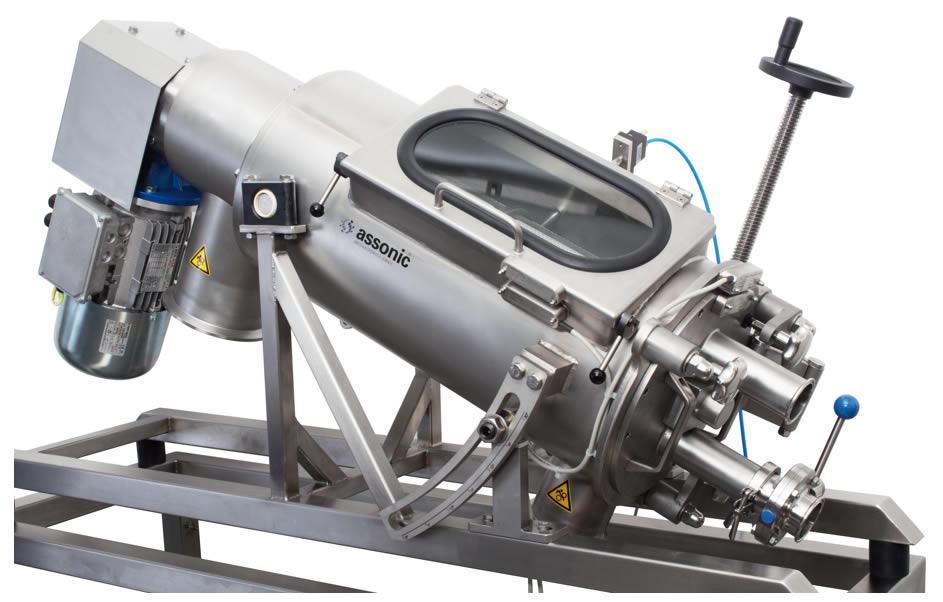
The crossflow filtration process in our RoSL 700 is supported by a patented ultrasonic technology to energize the filter media to achieve the often required high throughputs.. The heart of the unit is a woven stainless filter or a sintered laminate for fine filteration. A capacity range of 5000 - 6000 liters per hour and a filter rating of 25 micon have been achieved with low viscocity fluids. The seperator supports a wide range of processes including chemical processing, water treatment and beverage production.
The more robust RoSL 710 can be equipped with a wedge wire screen. This arangement is ideal for filtering high viscosity fluids with high solids contents. The applications range from biogas energy process to chocolate production.
The advantages of the improved Assonic technology are obvious:
- Environmentally friendly systems including no filter media to dispose of.
- Low energy consumption, a 1.5 KW motor drives the machine.
- Continous process with no interuptions, and no screen changes.
- Economical solution with a small footprint.
The all stainless steel construction of the assonic machine allows for ease of cleaning and long service life. The standard grade is 304ss, however higher grade alloys for more challenging applications are available. Food applications and agressive fluids can be processed with ease.
New Liquid-Solid Separator RoSL 700 with stainless steel filter
Continuous separation of small and medium loads of particles from high volumes of liquid can now be effectively done with the new assonic centrifugal separator. The machine can be used in various applications like waste and process water cleaning, plastic pellet separation and even in dairy production.
 The fluid flows through the round stainless steel filter accelerated by a rotator with up to 1000 rpm. The rotator also acts as a transportation tool for the solids. It pushes the particles through the filter and reduces the moisture content to very low levels before they leave the machine.
In finer filtration jobs the separation is supported by assonics Sonic Speed Screen ultrasonic technology. The range of possible separation cylinders starts with only 25 μm filters on the fine side, but often big openings of a few mm size are needed to reclaim product from process fluids. The filter elements are typically made in a robust construction by the Dorstener Drahtwerke Group.
The machine is made of all stainless steel. It is easy to control inline or in a batch mode.
Documents 1
Videos 1
Images 1