
Company profile
The company profile is shown in its original language.
MATH2MARKET GmbH develops GeoDict, a software platform for the 3D characterization, modeling, and simulation of materials and filtration processes. GeoDict supports the development and evaluation of filter media, cartridges, and filtration systems.
GeoDict creates detailed 3D digital models from micro-CT and FIB-SEM images, CAD geometries, or statistical material descriptions. It supports nonwovens, woven fabrics, membranes, meshes, ceramics, foams, and other porous materials. Advanced image processing, AI-assisted segmentation, and quantitative analysis reveal important microstructural properties.
GeoDict simulates fluid flow, pressure drop, particle capture, filtration efficiency, and filter loading. Simulations account for diffusion, inertial impaction, electrostatic interactions, and particle adhesion. Further capabilities include depth filtration, clogging, dust holding capacity, coalescence, cake formation, and adsorption.
Math2Market releases a new version of GeoDict every year, introducing features and improvements that specifically address evolving challenges in the filtration industry and support the development of advanced filtration solutions.
By combining microstructure analysis with predictive simulation, GeoDict helps engineers evaluate filtration performance, compare material designs, and reduce physical prototyping.
Product areas 12
Industries
- Aerospace Industry
- Automotive Industry
- Battery Industry (NEW in 2026)
- Biotechnology/Biopharmac. Industry
- CCUS (Carbon Capture, Utilization & Storage) NEW in 2026
- Chemical Industries
- Environmental Protection
- Filtration and Separation Industry
- Mineral / Oil / Gas Production
- Pharmaceutical Industry
- Textile Industry
- Waste Water Treatment
What's new 6
Simulation of adsorption-based processes and electrostatic filtration processes
GeoDict, the digital material laboratory from Math2Market, enables the virtual development and optimization of advanced filtration systems, reducing development time, prototyping costs, and time to market.
GeoDict provides advanced simulation capabilities for electrostatic filtration. Based on realistic 3D models of filter media, engineers investigate the combined effects of fiber geometry, pore structure, and electrostatic charge distribution on particle capture efficiency. Virtual testing helps optimize filter performance, reduce pressure drop, extend filter lifetime, and improve energy efficiency.
Also for adsorption-based processes, GeoDict supports the design and analysis of filter media and complete filter systems used in applications such as carbon capture, cabin air filtration, industrial gas purification, and water treatment. Realistic simulations of flow, diffusion, and adsorption allow to predict breakthrough behavior, adsorption capacity, and overall filter performance under real operating conditions. This makes it possible to evaluate design alternatives quickly and focus experimental testing on the most promising solutions.
By combining digital material characterization, physics-based simulation, and large-scale parameter studies in a single platform, GeoDict gives manufacturers a deeper understanding of filtration processes and supports the development of next-generation filter media and filtration systems.
Innovations for filtration simulation in the GeoDict 2021 release
Videos from the online 2020 User Meeting that took place on 21-25 September, 2020.
Playlist for all videos is available in the YouTube Math2Market channel - simply subscribe to it!
https://www.youtube.com/channel/UCRTnH7zN67h92iTHQaHQcow/playlists
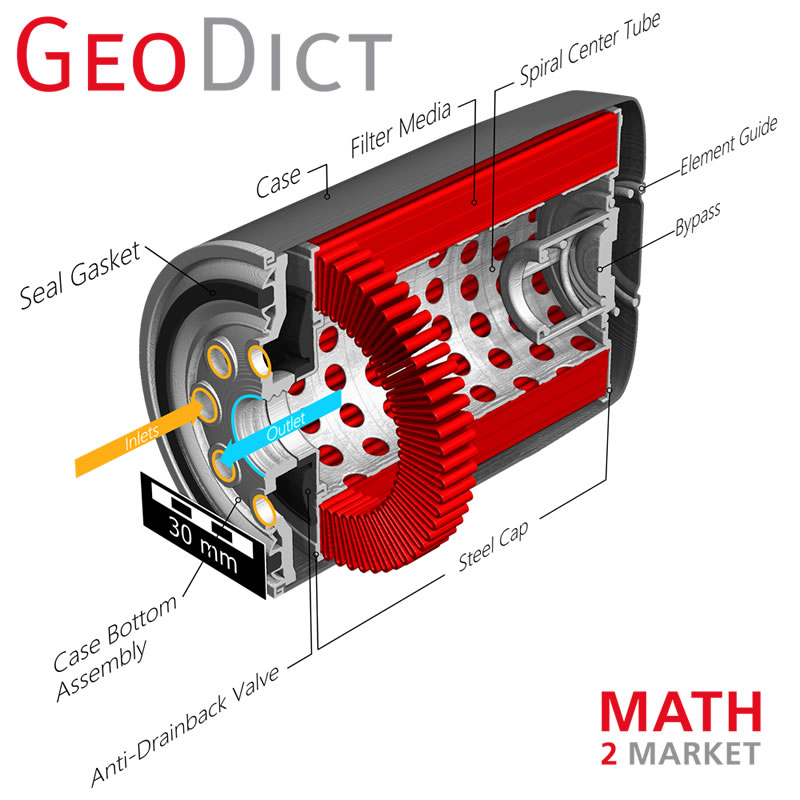
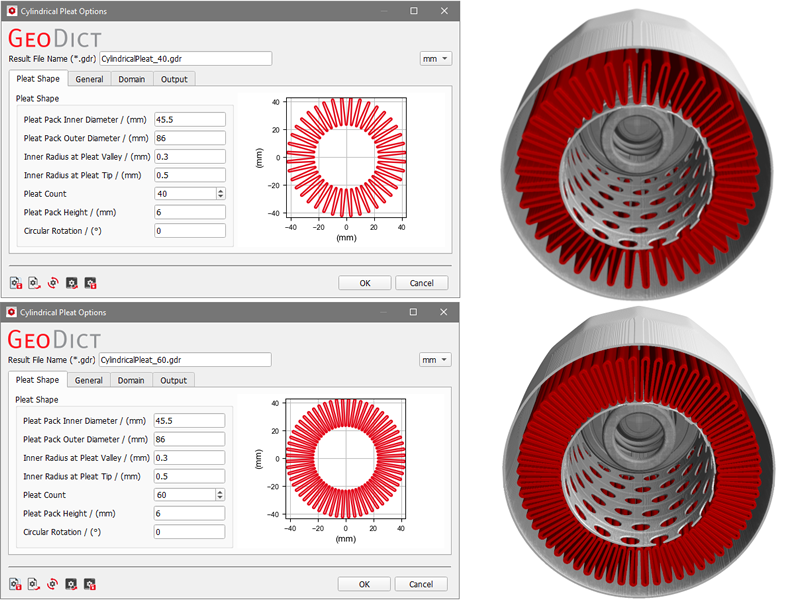
Digital design and virtual switching of cartridges to increase filter performance – the new GeoDict software feature
Computer-Aided-Design (CAD) is of keen interest to simulate flow and filtration on filters with cartridges. However, performing systematic simulations on different geometrical setups requires the generation of these structures as CAD individually and the import of each sample separately.
A new feature in the GeoDict software allows to generate a variety of cartridges with changing pleat count, pleat thickness, and number of porous layers, and digitally switch them inside the housing. Starting now, it is easy and quick to find the ideal configuration between filter area and pleat count for cartridges and their housing, regarding their local minimum pressure drop and many filtration relevant parameters.
This digital test of the performance of filter prototypes circumvents the need for expensive, trial-and-error manufacturing and testing phases, since only promising prototypes undergo measurements at the testbench. These systematic simulations with varying geometries or flow rates may be run simultaneously in cloud applications to further increase the productivity, fit customers requests, and decrease time-to-market.
More news (3)
GeoDict in ASTM E3278-21 International Standard
The simulation software GeoDict is presented in the ASTM E3278-21 international standard to digitally perform bubble point pressure testing of woven wire filter cloth.
Traditionally, the pore diameter is calculated using the measured pressure based on the Young-Laplace equation for the equilibrium of the gas pressure and surface tension forces. However, this equation is only for the perfect model (cylindrical pore, thin film with contact angle of 0°, isopropanol wetting liquid) and must be corrected by either the actual contact angle or a tortuosity factor for the filter cloth.
Alternatively, according to ASTM E3278-21, the software-based calculations of the PoroDict module of GeoDict are obtained through the non-circular cross-section of the bottle neck through-path of the filter cloth. This improves correlation and is able to generate a specific correction factor for each different filter cloth specification.
The ASTM E3278-21 standardizes software-based calculations of pore size through bubble point computations performed with the PoroDict module.
PoroDict quantitatively characterizes pore size, percolation path, tortuosity, bubble point pressure, and other parameters of the pore space, such as Pore Size Distribution (Granulometry and Porosimetry), Chord Length Distribution, open and closed porosity, and geodesic tortuosity.
Math2Market software products are a worthwhile new technological strategy, used by internationally renowned manufacturers in the filtration industry to optimize processes, to cut prototyping and R&D costs, to accelerate the design of filter and filter media greatly, and to boost their competitive edge.
Modeling, simulation, and optimization of filter media for protective face masks
In answering the global demand for safe personal protective equipment and the need for faster development and optimization of face masks, we demonstrate in a short video how GeoDict software is applied to design, model, simulate, analyze and optimize the filter media to improve the filter characteristics of face masks.
This unique digital workflow with GeoDict represents an efficient, sustainable and state-of-the-art methodology for digital R&D material design for porous media, explicitly shown here for a filter medium as an example.
These reliable quantitative simulations are the way to a time and cost saving approach for the development of new filter materials and filters with superior lifetime and performance. Development phases can be significantly accelerated thanks to shortened development times. The innovations can be developed much more easily by obtaining digitally unique insights and rich information about material prototypes and their properties, even before manufacturing them.
The GeoDict simulation software of Math2Market is part of the ASTM E2814-18 international standard
MATH2MARKET GmbH is a leader in providing software and consulting solutions for the design of innovative filter media, and for the improvement of filtration processes from its location in Kaiserslautern, Germany, near Frankfurt. Math2Market’s team, with an extensive research background, develops and supplies the GeoDict® software for R&D in numerous industries. For the filtration industry, Math2Market supports pioneering digital filter development and design to improve pressure drop, efficiency, and lifetime of filters, while at the same time greatly reducing, or even eliminating, expensive and time-consuming experimental testing.
Math2Market’s software GeoDict® only needs user-defined specifications, micro-CT and FIB/SEM images of filter media, or CAD models of filter elements to produce structural models of filter elements, pleats, and media (nonwoven, woven, metal and plastic meshes, synthetic media and papers, ceramics, open-cell foams, membranes, gradient materials…). Then, it analyzes pore size distribution, bubble point, fluid flow, pressure drop, particle capture, MPPS, depth filtration, clogging, dust holding capacity, and cake formation in the digital models. Gas filtration (air: DPF, HVAC) or liquid filtration (oil filter, hydraulic filters, sludge filtration, water, blood…) processes are simulated taking into account fluid density and viscosity, Brownian motion, inertial impaction, electrostatic forces, adhesion forces, and particle size and mass distribution. The possibilities of digital non-destructive testing are virtually boundless.
Math2Market software products are a worthwhile new technological strategy, used by internationally renowned manufacturers in the filtration industry to optimize processes, to cut prototyping and R&D costs, to accelerate the design of filters and filter media greatly, and to boost their competitive edge.
Documents 2
Videos 8
- DE #digitization #GeoDict GeoDict for Filtration - Filter Life-Time Prediction
- Optimizing the location of air purifiers with GeoDict
- Introduction to workshop on simulation of exhaust treatment
- Workshop on Simulation of particulate flows through whole filter with housing
- Design, modelling, simulation and optimization of filter media for face masks with GeoDict
- Modeling and Predicting Adsorption Processes in Porous Media
- Fast-Track Digital Design of High Performance Pleated Filters
- Short - Advanced Adsorption Modeling
Images 5
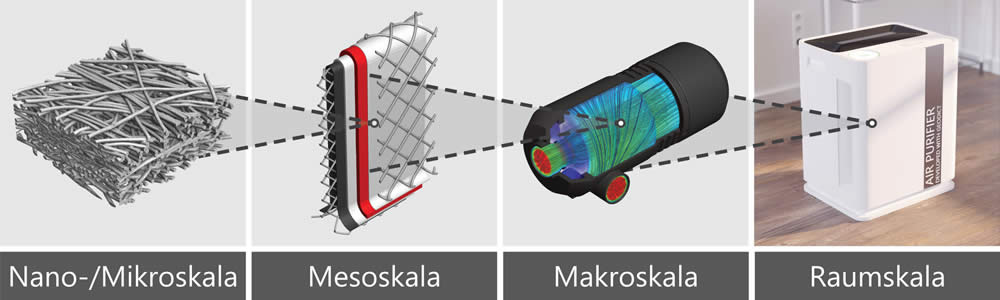
Multiscale filtration simulation: micro, meso, macro, and room scale
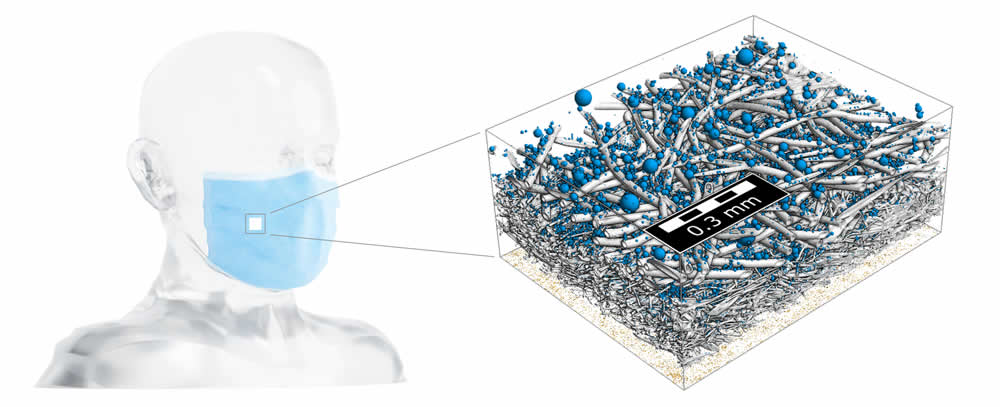
Simulation of filtration of protective face masks
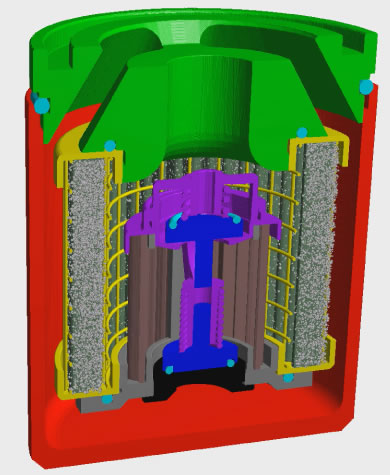
Simulation of filtration of particles in oil filter