
Fraunhofer Institute for Ceramic Technologies and Systems IKTS
- Booth
- Hall 8 · B40
- Country
- Germany
- Website
- ikts.fraunhofer.de/en.html
Company profile
Automatically translated with DeepL.
Fraunhofer Seramik Teknolojileri ve Sistemleri Enstitüsü (IKTS), yüksek performanslı seramikler üzerine uygulamalı araştırmalar yürütmektedir. Enstitünün Almanya’nın Dresden ve Hermsdorf (Turingiya) kentlerinde bulunan üç tesisi, seramik araştırmalarına adanmış Avrupa’nın en büyük Ar-Ge enstitüsünü oluşturmaktadır. Kapsamlı malzeme uzmanlığına dayanan enstitünün geliştirme çalışmaları, prototip üretimine kadar uzanan tüm değer yaratma zincirini kapsamaktadır. Fraunhofer IKTS, malzeme, teknoloji ve sistem uzmanlığından oluşan bir üçlü oluşturur ve bu üçlü, en üst düzeyde kapsamlı malzeme teşhisi ile güçlendirilmektedir.
Fraunhofer IKTS, membran teknolojisi alanındaki uzmanlığını, örneğin CO₂ ayrıştırma, su arıtma, merkezi olmayan oksijen üretimi ile hidrojen üretimi ve kullanımı gibi alanlarda aktif olarak ortaya koymaktadır. Başlıca uygulama alanları arasında sıvı filtrasyonu, membran kontaktörleri, pervaporasyon ve buhar geçirgenliği ile gaz ayrıştırma yer almaktadır.
Bu amaçla Fraunhofer IKTS, enerji verimli yüksek sıcaklıklı gaz ayırma süreçleri için olanlar gibi çok çeşitli membran malzemeleri ve katalizörler geliştirmektedir. Geliştirilen seramik, metalik ve kompozit bileşenler (sermetler), pilot tesislere kolayca entegre edilebilecek niteliktedir ve yüksek dolum yoğunlukları ile gaz akış hızları için optimize edilmiştir. Bir diğer önemli odak alanı ise, sıcak gaz toz giderimi ve partikül filtrasyonu için açık gözenekli, hücresel seramik gövdeler ve membranların yanı sıra, egzoz gazı arıtımı için seramik katalizör destekleri ve katalizörlerdir.
Product areas 18
- Arıtma İstasyonları
- Atıksu Filtreleri
- Dizel Motorlar için Partikül Filtreleri
- Gözenekli Seramikler
- Katkı İmalat
- Membran Test Donanımları
- Membranlar
- Mikrofiltrasyon
- Nanofiltrasyon
- Seramik Membranlar
- Seramik Separatörler
- Sıcak Gaz Filtreleri
- Su Filtreleri
- test Hizmetleri
- Topaklaştırıcılar
- Toz Gidericiler
- Ultrafiltrasyon
- Yağ Filtreleri
Industries
What's new 3
Hot Gas Filtration Solutions
The purification of particle-polluted exhaust gases at high temperatures (between 250 and 1000 °C) covers a wide range of applications. Major areas of application are the purification of waste gases from the glass and cement industries, from waste incineration plants and biomass gasification, as well as dust removal from gas, steam and combined cycle power plants. Other important applications are in the recovery of valuable materials from catalysts, fumed silica and metal powders. Due to the special filtration conditions and the special requirements on the properties and resistance of the materials, it represents a separate area of filtration.
Ceramic hot gas filter elements are used primarily when conventional or synthetic fabric filters reach their performance limits in cleaning particle-polluted exhaust gases. At temperatures above 800 °C and under very corrosive conditions, hot gas filters made from silicon carbide (SiC) are particularly suitable due to their thermal and chemical resistance. Other materials frequently used are aluminum oxide and cordierite. Good thermal conductivities or low co-efficients of thermal expansion form the basis for good thermal shock resistance of many ceramics, which makes these materials ideal for use under cyclic stresses. SiC hot gas filters are often able to offer cost-effective alternatives to expensive special alloys for filtering exhaust gases up to 1000 °C.
POXOS® - Lowest operating costs and CO2 emissions for local oxygen production
POXOS® generators produce pure oxygen (O2) on site. The patented membrane separation process requires significantly less electricity than pressure swing adsorption. With a high annual utilization rate, the operating costs are significantly lower than for oxygen supply by delivery. Besides, CO2 emissions from oxygen supply can be lowered by more than 50 percent.
Particularly high savings are achieved in wastewater treatment with ozone. The delivery, storage and evaporation of LOx (Liquid Oxygen - cryogenic liquid oxygen) to feed the ozone generators is no longer necessary. The oxygen rich off-gas leaving the wastewater is fed back to the POXOS® generator. The generated oxygen is fully utilized while a closed cycle of process is achieved. In addition, the usually required residual ozone eliminator is unnecessary. If the POXOS® - generator is operated with sewage gas, a CO2-neutral production of the oxygen is possible.
POXOS® generators are designed to be recycled at the end of their service life. The ceramic membrane material contained is fully recycled into the manufacturing process of new membranes to minimize the consumption of resources.
Solutions for water and gas purification
Fraunhofer IKTS has many years of experience in identifying and solving environmental technology issues in industry. Based on detailed process analyses, the advantages of high-performance ceramic materials are harnessed for the development of functional components in separation and reaction technology. The scientists then translate these components into economical system solutions, primarily for industrial water management, the manufacturing industry, mining, and agriculture. The materials and process engineering disciplines at Fraunhofer IKTS are closely interlinked in order to meet all relevant technological, legal, and economic requirements.
Successful approaches aim to combine ceramic membranes for micro-, ultra- and nanofiltration with electrochemical, sonochemical and photocatalytic processes (advanced oxidation processes, AOP). In many cases, specific sensor technology and classic aerobic and anaerobic treatment methods are also incorporated. The institute develops highly integrated components that combine processes such as filtration and adsorption or sono-electrochemical oxidation. The necessary sensor technology is developed and integrated according to requirements. Ceramic elements are the key to continuously expanding the performance of such highly integrated compact systems and the operating conditions (high temperatures, aggressive media). The new process combinations significantly reduce the energy consumption of water treatment. This increases process efficiency and environmental benefits while reducing process costs.
Videos 1
Images 3
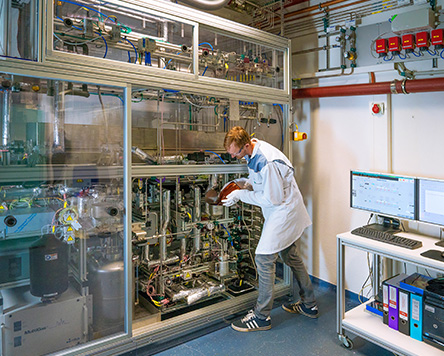
Test rig for steady-state and dynamic tests on particulate filters and catalytic converters
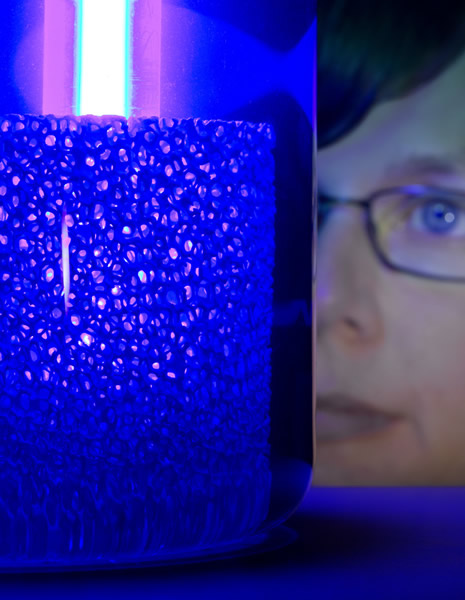
Photocatalytically effective ceramic foams.
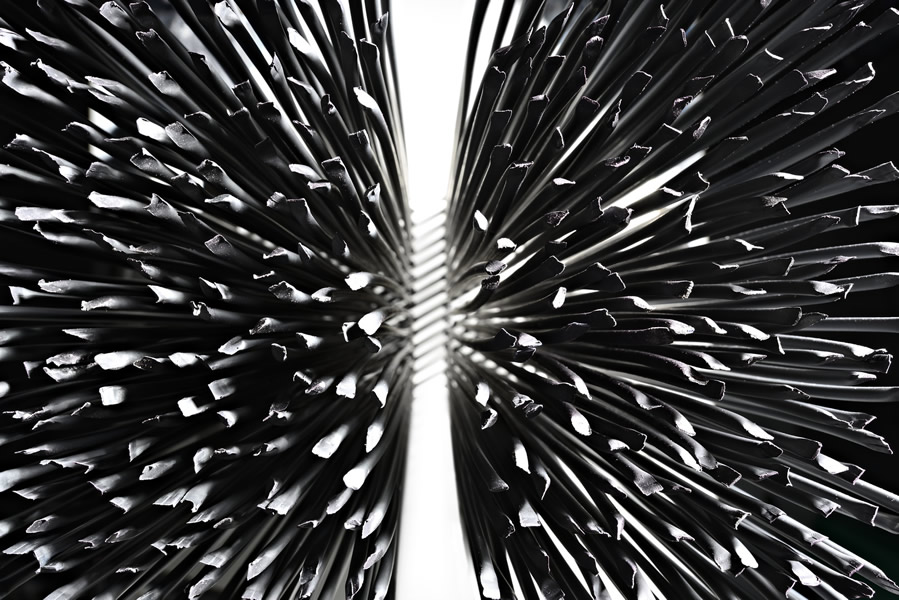
POXOS® uses special membranes from Fraunhofer IKTS for the energy-efficient production of pure oxygen.