
Fraunhofer Institute for Ceramic Technologies and Systems IKTS
- Booth
- Hall 8 · B40
- Country
- Germany
- Website
- ikts.fraunhofer.de/en.html
Company profile
Automatically translated with DeepL.
프라운호퍼 세라믹 기술 및 시스템 연구소(IKTS)는 고성능 세라믹에 대한 응용 연구를 수행합니다. 독일 드레스덴과 헤르름스도르프(튀링겐주)에 위치한 이 연구소의 세 곳의 캠퍼스는 종합적으로 유럽 최대 규모의 세라믹 전문 연구개발 기관을 형성하고 있습니다. 포괄적인 재료 전문 지식을 바탕으로, 이 연구소의 개발 업무는 시제품 생산에 이르기까지 가치 창출의 전 과정을 아우릅니다. 프라운호퍼 IKTS는 재료, 기술, 시스템 전문 지식을 삼위일체로 결합하고 있으며, 최고 수준의 광범위한 재료 진단 기술을 통해 이를 더욱 강화하고 있습니다.
프라운호퍼 IKTS는 CO₂ 분리, 수처리, 분산형 산소 생산, 수소 생산 및 활용 분야 등에서 막 기술에 대한 전문 지식을 적극적으로 기여하고 있습니다. 주요 응용 분야로는 액체 여과, 막 접촉기, 퍼바포레이션 및 증기 투과, 가스 분리 등이 있습니다.
이를 위해 프라운호퍼 IKTS는 에너지 효율이 높은 고온 가스 분리 공정용 소재를 비롯해 다양한 막 소재와 촉매를 개발하고 있습니다. 개발된 세라믹, 금속 및 복합 소재(세라메트) 부품은 파일럿 플랜트에 쉽게 통합될 수 있으며, 높은 충진 밀도와 가스 유량에 최적화되어 있습니다. 또 다른 주요 연구 분야는 고온 가스 내분진 제거 및 입자 여과를 위한 개방 기공형 셀룰러 세라믹 본체 및 막, 그리고 배기가스 정화를 위한 세라믹 촉매 지지체 및 촉매입니다.
Product areas 18
Industries
What's new 3
Hot Gas Filtration Solutions
The purification of particle-polluted exhaust gases at high temperatures (between 250 and 1000 °C) covers a wide range of applications. Major areas of application are the purification of waste gases from the glass and cement industries, from waste incineration plants and biomass gasification, as well as dust removal from gas, steam and combined cycle power plants. Other important applications are in the recovery of valuable materials from catalysts, fumed silica and metal powders. Due to the special filtration conditions and the special requirements on the properties and resistance of the materials, it represents a separate area of filtration.
Ceramic hot gas filter elements are used primarily when conventional or synthetic fabric filters reach their performance limits in cleaning particle-polluted exhaust gases. At temperatures above 800 °C and under very corrosive conditions, hot gas filters made from silicon carbide (SiC) are particularly suitable due to their thermal and chemical resistance. Other materials frequently used are aluminum oxide and cordierite. Good thermal conductivities or low co-efficients of thermal expansion form the basis for good thermal shock resistance of many ceramics, which makes these materials ideal for use under cyclic stresses. SiC hot gas filters are often able to offer cost-effective alternatives to expensive special alloys for filtering exhaust gases up to 1000 °C.
POXOS® - Lowest operating costs and CO2 emissions for local oxygen production
POXOS® generators produce pure oxygen (O2) on site. The patented membrane separation process requires significantly less electricity than pressure swing adsorption. With a high annual utilization rate, the operating costs are significantly lower than for oxygen supply by delivery. Besides, CO2 emissions from oxygen supply can be lowered by more than 50 percent.
Particularly high savings are achieved in wastewater treatment with ozone. The delivery, storage and evaporation of LOx (Liquid Oxygen - cryogenic liquid oxygen) to feed the ozone generators is no longer necessary. The oxygen rich off-gas leaving the wastewater is fed back to the POXOS® generator. The generated oxygen is fully utilized while a closed cycle of process is achieved. In addition, the usually required residual ozone eliminator is unnecessary. If the POXOS® - generator is operated with sewage gas, a CO2-neutral production of the oxygen is possible.
POXOS® generators are designed to be recycled at the end of their service life. The ceramic membrane material contained is fully recycled into the manufacturing process of new membranes to minimize the consumption of resources.
Solutions for water and gas purification
Fraunhofer IKTS has many years of experience in identifying and solving environmental technology issues in industry. Based on detailed process analyses, the advantages of high-performance ceramic materials are harnessed for the development of functional components in separation and reaction technology. The scientists then translate these components into economical system solutions, primarily for industrial water management, the manufacturing industry, mining, and agriculture. The materials and process engineering disciplines at Fraunhofer IKTS are closely interlinked in order to meet all relevant technological, legal, and economic requirements.
Successful approaches aim to combine ceramic membranes for micro-, ultra- and nanofiltration with electrochemical, sonochemical and photocatalytic processes (advanced oxidation processes, AOP). In many cases, specific sensor technology and classic aerobic and anaerobic treatment methods are also incorporated. The institute develops highly integrated components that combine processes such as filtration and adsorption or sono-electrochemical oxidation. The necessary sensor technology is developed and integrated according to requirements. Ceramic elements are the key to continuously expanding the performance of such highly integrated compact systems and the operating conditions (high temperatures, aggressive media). The new process combinations significantly reduce the energy consumption of water treatment. This increases process efficiency and environmental benefits while reducing process costs.
Videos 1
Images 3
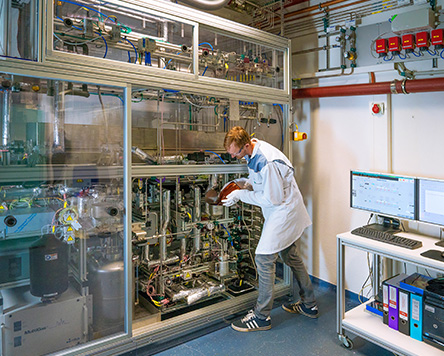
Test rig for steady-state and dynamic tests on particulate filters and catalytic converters
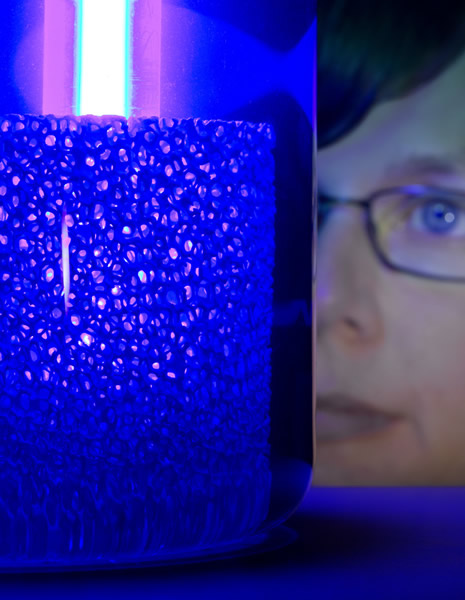
Photocatalytically effective ceramic foams.
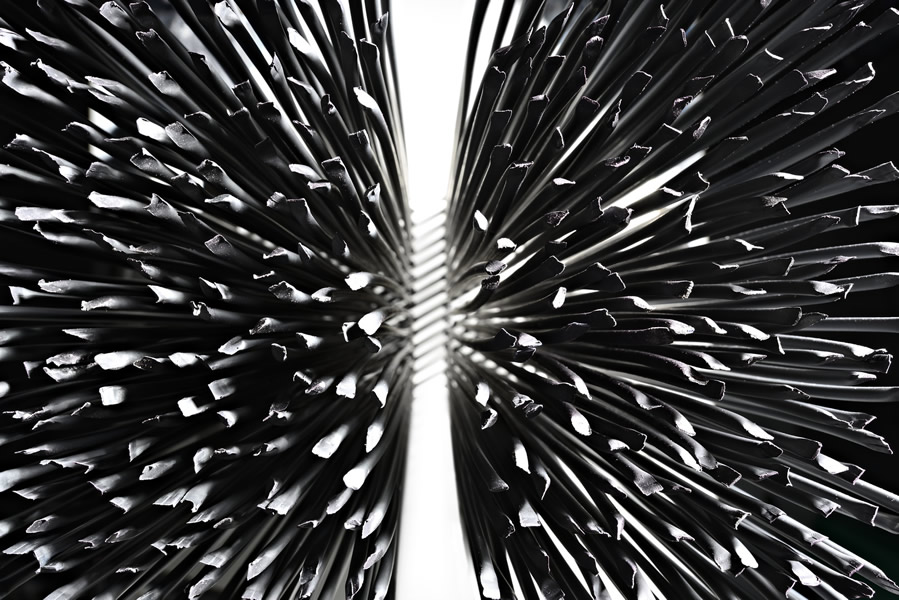
POXOS® uses special membranes from Fraunhofer IKTS for the energy-efficient production of pure oxygen.